Posts Tagged - fertiliser

Home fertiliser

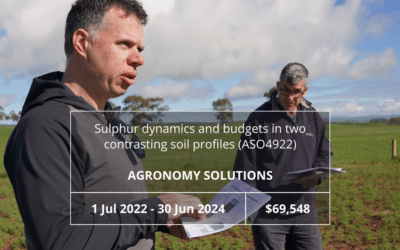
Evaluating commercial products to enhance phosphorus fertiliser efficiency (ASO5225)

This project addresses one of SAGIT’s issues of significance, a critical evaluation of products claimed to improve the efficacy of phosphorus fertilisers. This will be done by focusing on improving Phosphorus Use Efficiency (PUE) on moderate to highly calcareous soils that are present on Eyre Peninsula, Yorke Peninsula, Mid-North and the Upper South East broadacre cropping regions.

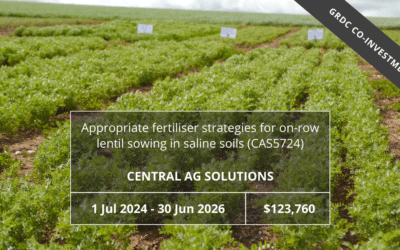
Appropriate fertiliser strategies for on-row lentil sowing in saline soils (CAS5724)

This project aims to determine the residual benefit of on-row and off-row sowing and appropriate fertiliser strategies for sensitive lentil crops in phosphorus deficient and moderately saline calcareous soil types of Yorke Peninsula. Research will investigate management techniques of utilising residual phosphorous in a cereal phase along with phosphorous placement at seeding to optimise lentil grain yields and economic returns. This project is a co-investment, with GRDC providing 50% of the total funding.
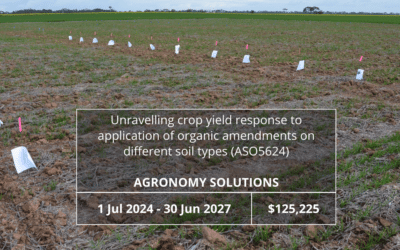
Unravelling crop yield response to application of organic amendments on different soil types (ASO5624)

This project aims to assess the impact of organic amendments on soil condition and crop response on three contrasting soil types. Through this process, the aim is to provide growers with recommendations on ‘target soils’ where organic amendment applications can provide maximum benefit. Researchers will endeavour to define suitable frequency and application rates of organic amendments in combination with inorganic fertiliser.

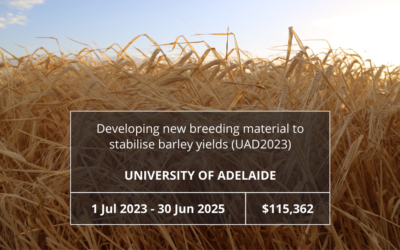
Developing new breeding material to stabilise barley yields (UAD2023)

South Australian crops can be severely impacted by poor and variable growing conditions, which includes low-fertility soils. Crop plants possess strong instincts to reduce grain number due to variable growing conditions or reduced fertiliser. This is a major contributor to the yield gap in SA. This project seeks to help close this yield gap through the import and testing of new genetic material that makes barley less responsive to environmental conditions.