This project offers a regionally based internship program, providing a stepping-stone for early career researchers to receive high quality training and hands-on experience to develop their research skills. This program supports young researchers interested in grains RD&E to pursue further research roles while increasing research capacity within the grains industry. This project is a co-investment, with the SA Drought Hub providing an additional $34,068 funding.
Latest Blogs - Current Projects
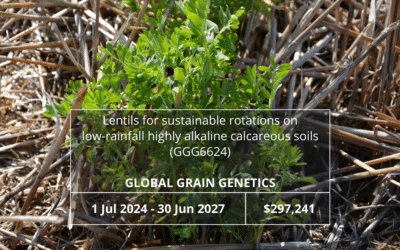
Lentils for sustainable rotations on low-rainfall highly alkaline calcareous soils (GGG6624)
Jul 11, 2024 | Current Projects
This project will improve the sustainability of SA’s diverse and expansive low rainfall cropping areas by expanding lentil production, as a legume break crop for cereals, on highly alkaline calcareous soils in these regions. It will build on the recent successful research, extension and expansion of lentil through the low rainfall Mallee type areas across South Australia, by targeting constraints to profitable production with a focus on the Upper Eyre Peninsula (UEP).
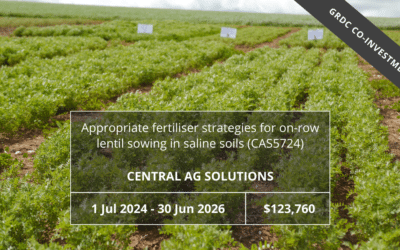
Appropriate fertiliser strategies for on-row lentil sowing in saline soils (CAS5724)
Jul 11, 2024 | Current Projects
This project aims to determine the residual benefit of on-row and off-row sowing and appropriate fertiliser strategies for sensitive lentil crops in phosphorus deficient and moderately saline calcareous soil types of Yorke Peninsula. Research will investigate management techniques of utilising residual phosphorous in a cereal phase along with phosphorous placement at seeding to optimise lentil grain yields and economic returns. This project is a co-investment, with GRDC providing 50% of the total funding.
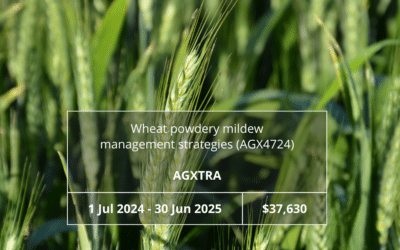
Wheat powdery mildew management strategies (AGX4724)
Jul 11, 2024 | Current Projects
This project aims to demonstrate to growers and agronomists the effectiveness of existing and emerging wheat powdery mildew (WPM) control options across varieties with diverse susceptibility ratings. It will also raise awareness of the importance of cultural considerations with regards to WPM management and an understanding of pathogen resistance to commonly used fungicides. This project provides an opportunity to extend existing knowledge generated through current SAGIT-funded WPM projects.
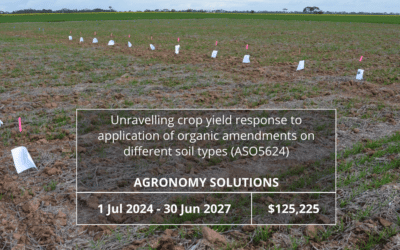
Unravelling crop yield response to application of organic amendments on different soil types (ASO5624)
Jul 11, 2024 | Current Projects
This project aims to assess the impact of organic amendments on soil condition and crop response on three contrasting soil types. Through this process, the aim is to provide growers with recommendations on ‘target soils’ where organic amendment applications can provide maximum benefit. Researchers will endeavour to define suitable frequency and application rates of organic amendments in combination with inorganic fertiliser.
Developing a DGT methodology to assess bioavailability of herbicide residues (USA121)
Nov 23, 2023 | Current Projects
A robust testing system for imidazolinone residues is to be developed using Diffusive Gradient in Thin-Films (DGT) technology. This tool will provide information on bioavailability of herbicide residues independent of soil type characteristics. The DGT tool will be validated in spiked soils, in a range of soil types and two water regimes. The DGT tool for glyphosate residue is also to be assessed.
Pesticide effects on soil microbial functions in contrasting SA soils (USA3323)
Nov 23, 2023 | Current Projects
The aim of this project is to understand how soil properties influence the effects of pesticides on soil health. The project team will assess six targeted pesticides in 10 contrasting South Australian broadacre cropping soils. This knowledge will deliver farmers essential information for identifying the best pesticide-soil combinations to maintain healthy soil microbial communities.
Canola profitability as a break crop in the Upper North (UNF2822)
Nov 23, 2023 | Current Projects
This project aims to explore if new canola technology allows it to be a more reliable and viable break crop option in the Upper North agricultural zone. The project will assess the profitability of different canola agronomy packages in local validation trials (GM vs open pollinated TT) against wheat over a three-year period.